Skincare routine for perimenopause dryness

Table of Contents
- Why your skin's gone completely parched during perimenopause
- The gentle cleanser for dry skin that won't strip you further
- Best moisturiser for perimenopause dry skin: what actually matters
- Skincare ingredients for menopausal skin that do the heavy lifting
- How long does skincare take to help dry skin, really
- The mistakes you're probably making right now
- Your actual routine: the order that counts
- Frequently Asked Questions
Last Updated: October 18, 2026
Why your skin's gone completely parched during perimenopause
Oestrogen doesn't just affect your mood and sleep, it's been quietly keeping your skin plump and hydrated for decades, which is why perimenopause dryness skincare becomes essential when those levels drop. When oestrogen levels start dropping during perimenopause, your skin loses one of its most reliable moisture-retention mechanisms. Your skin barrier weakens. Oil production tanks. Suddenly you're dealing with dryness that no amount of water-drinking seems to fix.
This isn't vanity. When your skin feels uncomfortable, everything feels harder. You're already managing brain fog, night sweats, and that wired-and-tired feeling that makes you want to scream. Adding tight, flaky, uncomfortable skin to that mix is just cruel.
The good news? A solid perimenopause dryness skincare routine doesn't have to be complicated or time-consuming. It's about working with what your skin actually needs right now, not chasing trends or pretending your 25-year-old routine still works.
When your skin feels good, your confidence follows.
The gentle cleanser for dry skin that won't strip you further
Stop using whatever you used in your 30s. Seriously.
Most cleansers are designed to remove oil. During perimenopause, you don't have excess oil to remove, you have a skin barrier that's already struggling. A harsh cleanser is like sandpapering a wall that's already cracked.
A gentle cleanser for dry skin does one thing really well: it removes dirt and makeup without disrupting your skin's natural protective layer. Look for cleansers that are cream-based or oil-based rather than foaming. Foaming cleansers are typically surfactant-heavy, which strips moisture faster than your skin can replace it.
The best approach is double cleansing if you're wearing makeup or sunscreen. First, use an oil or balm cleanser to dissolve makeup and sunscreen. Then follow with a gentle cream or milk cleanser to remove any residue. This two-step process is thorough without being harsh.
Temperature matters too. Hot water opens your pores and can increase water loss from your skin. Lukewarm water is your friend here, it's warm enough to feel nice but won't compromise your barrier further.
Timing is worth mentioning: cleanse morning and night, but if your skin feels particularly tight after cleansing, you're using something too strong. Switch immediately. Your skin is telling you something.
Best moisturiser for perimenopause dry skin: what actually matters
Here's where most guides go wrong. They talk about ingredients without explaining why those ingredients matter right now for your skin.
The best moisturiser for perimenopause dry skin does three things simultaneously: it hydrates (adds water to your skin), it occludes (seals that water in), and it supports your compromised barrier.
Hydrators draw water into your skin. Look for humectants like glycerinee, hyaluronic acid, or panthenol. These work by pulling moisture from the air and deeper skin layers into the outer layer.
Occlusives seal everything in. Ingredients like ceramides, squalane, and plant oils create a protective layer that stops water from evaporating. Without this seal, hydrators alone won't solve your problem.
Barrier-supporting ingredients are the third piece. Niacinamide helps your skin produce its own ceramides. Peptides support collagen production. Centella asiatica calms inflammation that often accompanies compromised barriers.
The texture matters as much as the formula. During perimenopause, a lightweight moisturiser often isn't enough. You likely need something richer, a cream or balm rather than a gel or lotion. If your skin still feels tight 30 minutes after moisturising, you need something more occlusive.
Apply moisturiser to damp skin immediately after cleansing. This locks in hydration rather than just sitting on the surface.
Skincare ingredients for menopausal skin that do the heavy lifting
Not all ingredients are created equal when your skin is in hormonal flux. Some are genuinely transformative. Others are nice-to-haves that won't address your actual problem.
Hyaluronic acid holds up to 1000 times its weight in water. During perimenopause when your skin's natural hydration is compromised, this becomes essential rather than optional. It works best in humid environments or when applied to damp skin.
Ceramides are lipids your skin naturally produces less of during perimenopause. They're critical for barrier function. When your barrier is compromised, ceramides help restore it. Look for ceramide NP, AP, or EOP in your ingredient list.
Niacinamide (vitamin B3) strengthens your skin barrier by supporting ceramide and collagen production. Research shows it's particularly effective for compromised barriers. It also has anti-inflammatory properties, which matters when your skin is irritated from dryness.
Centella asiatica (also called cica or tiger grass) calms inflammation and supports collagen synthesis. It's especially useful if your dryness is accompanied by sensitivity or redness.
Squalane is a lightweight oil that mimics your skin's natural sebum. It's occlusive without feeling heavy, making it ideal for perimenopause when you need barrier support but don't want a thick, greasy layer.
Peptides signal your skin to produce more collagen. During perimenopause when collagen production naturally declines, this becomes more important. They work best as part of a consistent routine over weeks, not days.
The mistake most people make is chasing trending ingredients rather than addressing the fundamentals. A routine with hyaluronic acid, ceramides, and niacinamide will transform your skin more reliably than adding the latest buzzword ingredient.
How long does skincare take to help dry skin, really
This is where patience becomes your actual superpower.
Your skin cells turn over roughly every 28 days. Meaningful changes in hydration and barrier function take at least 4-6 weeks of consistent use. If you're switching routines every two weeks because you're not seeing results, you're sabotaging yourself.
Week one: Your skin might feel slightly better immediately from the hydration, but this is mostly surface-level. You're not seeing structural changes yet.
Weeks two to three: If you're using barrier-supporting ingredients like ceramides or niacinamide, your skin is starting to rebuild. You might notice less tightness and slightly more suppleness.
Weeks four to six: This is when real changes become visible. Your skin barrier is functioning better. Dryness improves noticeably. Fine lines from dehydration start to soften.
Eight weeks and beyond: If you've stuck with your routine, your skin should feel genuinely different. Not just hydrated on the surface, but actually resilient.
The consistency matters more than the complexity. A simple routine used every single day beats an elaborate routine used sporadically.
The mistakes you're probably making right now
Over-exfoliating. When your skin is dry, the instinct is often to exfoliate to remove flakiness. This is backwards. Exfoliating compromised skin makes it worse. Skip physical exfoliants entirely during perimenopause. If you want chemical exfoliation, use it sparingly, once weekly at most, and only if your skin isn't already irritated.
Skipping the moisturiser step. Some people think moisturiser is optional if they're using hydrating serums. It's not. Serums hydrate; moisturisers seal. You need both.
Using too many active ingredients. Retinol, vitamin C, acids, peptides, they're all useful, but layering too many simultaneously during perimenopause overwhelms your already-compromised barrier. Stick to one or two actives maximum, and always follow with a rich moisturiser.
Applying products to completely dry skin. Products absorb better into damp skin. If you're waiting for your skin to be bone-dry before applying moisturiser, you're reducing how much hydration actually gets in.
Ignoring your neck and décolletage. These areas have fewer oil glands and thinner skin, making them more prone to dryness during perimenopause. Extend your routine to these areas, they'll show your age faster if neglected.
Switching routines constantly. Your skin needs consistency to rebuild its barrier. Give any routine at least six weeks before deciding it's not working.
Your actual routine: the order that counts
The order you apply products matters because it affects how well they absorb and work together.
Morning routine:
- Cleanse with a gentle cream or milk cleanser on damp skin
- Apply any hydrating toner or essence (optional but helpful)
- Apply serums with hydrating ingredients like hyaluronic acid
- Apply your best moisturiser for perimenopause dry skin
- Apply sunscreen (SPF 30 minimum)
Evening routine:
- Double cleanse: oil or balm cleanser first, then gentle cream cleanser
- Apply any active ingredients (retinol, vitamin C) to completely dry skin if using
- Wait 10-15 minutes if you've used actives
- Apply hydrating serums
- Apply a richer night moisturiser or balm
- Optional: apply a facial oil over your moisturiser for extra occlusion
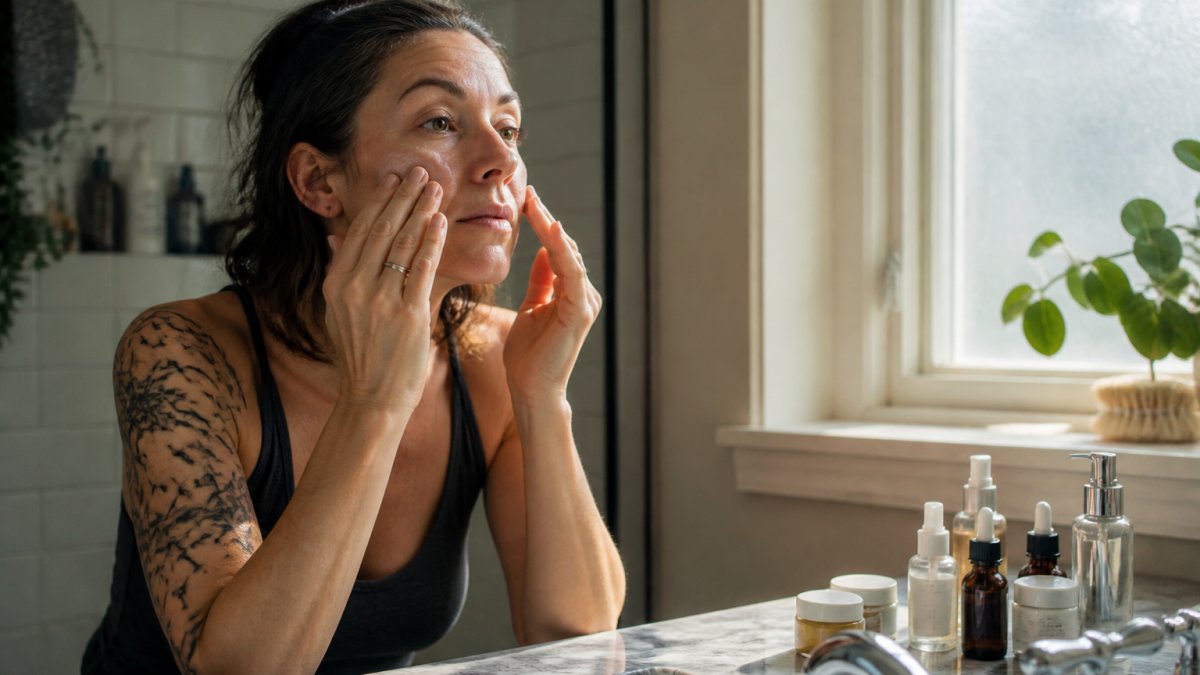
The key principle: hydrate first (lightest texture), then occlude (richer texture). This layering approach ensures hydration gets in and stays in.
During perimenopause, your skin barrier is doing its best with less oestrogen support. A routine that respects this shift, gentle cleansing, targeted hydration, and proper occlusion, makes an enormous difference in how your skin looks and feels.
Your skin doesn't need to feel tight, flaky, or uncomfortable. It also doesn't need an elaborate 10-step routine. It needs consistency, the right ingredients for this specific phase of your life, and products applied in an order that actually works.
When your skin feels good, you feel more like yourself. That confidence isn't shallow, it's the foundation for everything else.
Frequently Asked Questions
Why does perimenopause dryness happen to your skin?
Oestrogen levels drop during perimenopause, and your skin loses its ability to hold onto moisture. Your skin barrier gets thinner, oil production plummets, and everything feels tight and uncomfortable. It's not just you, it's your hormones throwing a tantrum. The good news: a solid skincare routine for perimenopause dryness can help your skin adapt and feel better within weeks.
How long does it take for a skincare routine to help dry skin?
Most people notice their skin feeling less tight and more hydrated within 2-3 weeks of consistent use. Real transformation, plumper texture, less flaking, smoother tone, typically shows up around 6-8 weeks. Stick with it. Your skin cells turn over on their own schedule, not yours.
What skincare ingredients for menopausal skin actually work?
Look for humectants like glycerine and hyaluronic acid (they pull moisture into your skin), ceramides (they repair your barrier), and niacinamide (it calms irritation and supports skin strength). Avoid anything with alcohol or heavy fragrance. Your skin is sensitive right now, and it needs ingredients that support, not stress it.
Should I use a completely different routine during perimenopause?
Not a complete overhaul, but yes, adjust it. Swap your cleanser for something gentler, upgrade to a richer moisturiser, and add a hydrating serum if your current routine isn't cutting it. Your skin's needs have changed, so your routine needs to change with it. Think of it as levelling up, not starting over.
If symptoms are hitting you hard, it's always smart to speak to an expert via our friends at UnPause.com.au. Dead Tired Club does not provide medical advice.