Rave Therapy for Midlife: Why Dancing Is the Ultimate Reset

Last Updated: November 15, 2026
Quick Summary
Rave therapy is the deliberate use of loud music, rhythmic movement and a shared dance floor to shift your mental state. Dancing at raves combines physical activity, rhythm, music and social contact in a single act, giving you somewhere to put the week's stress. It is not a clinical treatment or a cure, but one way many women choose to shake off the week.
- Rave therapy is not a clinical treatment, a substitute for care or a cure for anything.
- Dancing stacks physical activity, rhythm, music and social contact into one night out.
- Treat a rave like a marathon, not a sprint, and plan hydration, shoes and an exit.
- Standing near speakers can leave you with ringing ears, so consider music earplugs.
- The evidence for dancing and mental health is still developing, so nobody should claim certainty.
Table of Contents
- Rave Therapy: The Midlife Reset Nobody Told You About
- The Benefits of Dancing for Mental Health After 40
- Live Music and Wellbeing: Why a Gig Hits Different in Midlife
- Reconnecting With Yourself: Identity, Freedom and the Dance Floor
- Community and Belonging: Finding Your People in Rave Culture
- How to Enjoy a Rave in Midlife Without Wrecking Yourself
- The Honest Bit: Evidence, Limits and What Dancing Cannot Fix
- Join the Club: Gear for Women Who Still Want to Go Out
- Frequently Asked Questions
Rave Therapy: The Midlife Reset Nobody Told You About
Here's a claim you won't hear from a beige wellness brand: rave therapy is the midlife reset nobody told you about, and it costs less than a course of anything sold in a clinic waiting room. Dancing at raves can be a joyful way to move through the week's stress, because it gives you somewhere to put everything you've been carrying. At Dead Tired Club, we've spent years talking to women who are wired, tired and thoroughly over being told to try a gentle walk. First, though, here's what most guides get wrong.
Most guides treat midlife dancing as nostalgia. A cute trip down memory lane for women who should know better. That framing misses the point entirely.
Rave therapy is the deliberate use of loud music, rhythmic movement and a shared dance floor to shift your mental state. It is not a clinical treatment, it is not a substitute for care, and it is not a cure for anything. It is one way many women choose to shake off the week.
The Benefits of Dancing for Mental Health After 40
The benefits of dancing for mental health are the reason this conversation is worth having at all. Dancing combines physical activity, rhythm, music and social contact in a single act, which is a lot of wellbeing stacked into one night out. For women aged 40 to 65, that combination lands differently than it did at 22. You're not dancing to escape your life anymore. You're dancing to remember you're still in it.
Stress Relief, Emotional Release and the Dance Floor
Stress relief is the first thing most women mention, and emotional release is the second. There's something about a dark room, a bassline you can feel in your ribs and nobody watching you that lets the week fall off. Many women find that a couple of hours of proper dancing helps them loosen up.
The dance floor works as a coping mechanism precisely because it doesn't ask you to talk about anything. You sweat, you move, you yell something stupid with a stranger, and you go home lighter.
Movement, Mood and the Endorphin Glow
Many people find movement lifts their mood, which is part of why a good night can leave you feeling warm, loose and slightly smug. Dancing is also a form of physical activity, which can feel more fun than a gym session.
That glow has a skincare angle, and we're not being cute about it. A good night out can leave you looking and feeling refreshed the next morning, and that's when a bit of skincare support can feel good.

Live Music and Wellbeing: Why a Gig Hits Different in Midlife
A gig can hit differently in midlife because you're no longer there by accident. You chose it. You booked the babysitter, you cleared the calendar, you drove there.
There's also the volume.
Loud, rhythmic music and moving with a crowd can be an enjoyable social experience, and looking forward to a night out can be a pleasure in itself.
For some women, a gig can become a monthly highlight rather than a rare exception. That's worth planning around.
Watch out: volume is the part that bites. Standing near the speakers for a long time can leave you with ringing ears, so consider earplugs designed for music to help protect your hearing.
There's a skincare angle here too.
Reconnecting With Yourself: Identity, Freedom and the Dance Floor
Reconnecting with yourself is the benefit nobody warns you about. Somewhere between school runs, performance reviews and being everyone's default problem-solver, a lot of us misplaced our identity. Not dramatically. Just quietly, one cancelled night out at a time.
Self-expression on a dance floor is judgment-free in a way almost nowhere else is. You are not someone's mother there. You are not someone's colleague. You're a woman in a room full of noise, moving how she likes, and that freedom is genuinely restorative. Many women find one good night reminds them who they were before they became a schedule.
Community and Belonging: Finding Your People in Rave Culture
Community and belonging are where rave culture quietly outperforms most wellness offerings. At its best, rave culture is inclusive by design: nobody is checking your age, your outfit or your ability to stay out until dawn.
But let's be honest about the barriers, because a guide that pretends they don't exist isn't a guide. Cost is the first one: tickets, transport, drinks and childcare can add up.
None of that means rave culture is closed to you. It means the belonging is worth building deliberately rather than hoping it happens. A few things that genuinely help:
- Go with at least one person who matches your energy, so nobody is dragging anyone.
- Pick venues that publish access information, and don't be shy about ringing ahead.
- Choose daytime or early-evening events if late nights are the sticking point.
- Agree a check-in text with a friend at a set time, so nobody is left wondering.
- Say yes to the smaller, friendlier nights before you say yes to the big one.
If you're craving that sense of belonging, you don't have to find it at 2am. There's a whole community for women who lived loud and still want to go out, and it's a far easier place to start than a stranger's warehouse.
Watch out: the inclusivity of rave culture is real but not automatic. If a night feels off, the crowd, the venue, the vibe, leaving is always allowed, and it's not a failure. The whole point is to come home feeling more like yourself, not less.
How to Enjoy a Rave in Midlife Without Wrecking Yourself
How to enjoy a rave in midlife comes down to one principle: treat it like a marathon, not a sprint. The women who have a brilliant night and a functional Sunday are the ones who planned. Here's the short version.
| What | Why it matters | When |
|---|---|---|
| Hydration before and during | Prevents the 3am headache | From mid-afternoon |
| Comfortable shoes | You will dance more than you think | Before you leave |
| A friend who matches your energy | Nobody wants to be the one dragging | Before booking |
| An exit plan | Leaving at midnight is a win, not a failure | Before you go |
| Ear protection | Protect the hearing you still need | On arrival |
| Water, not just drinks | Alcohol wrecks sleep more at 45 | All night |
Watch out: the biggest mistake is trying to keep pace with a 26-year-old. You will lose, and you'll lose the following two days as well.
What to Wear, Bring and Plan Before a Late Night
What to wear matters more than you'd think, because discomfort is what sends you home early. Go for something soft, oversized and breathable that you can dance in without adjusting every four minutes. Our Retired Raver Sporty Jersey exists for precisely this, and if you want more ideas, there are seven ways to style sporty jerseys for comfort that work for a long night out.
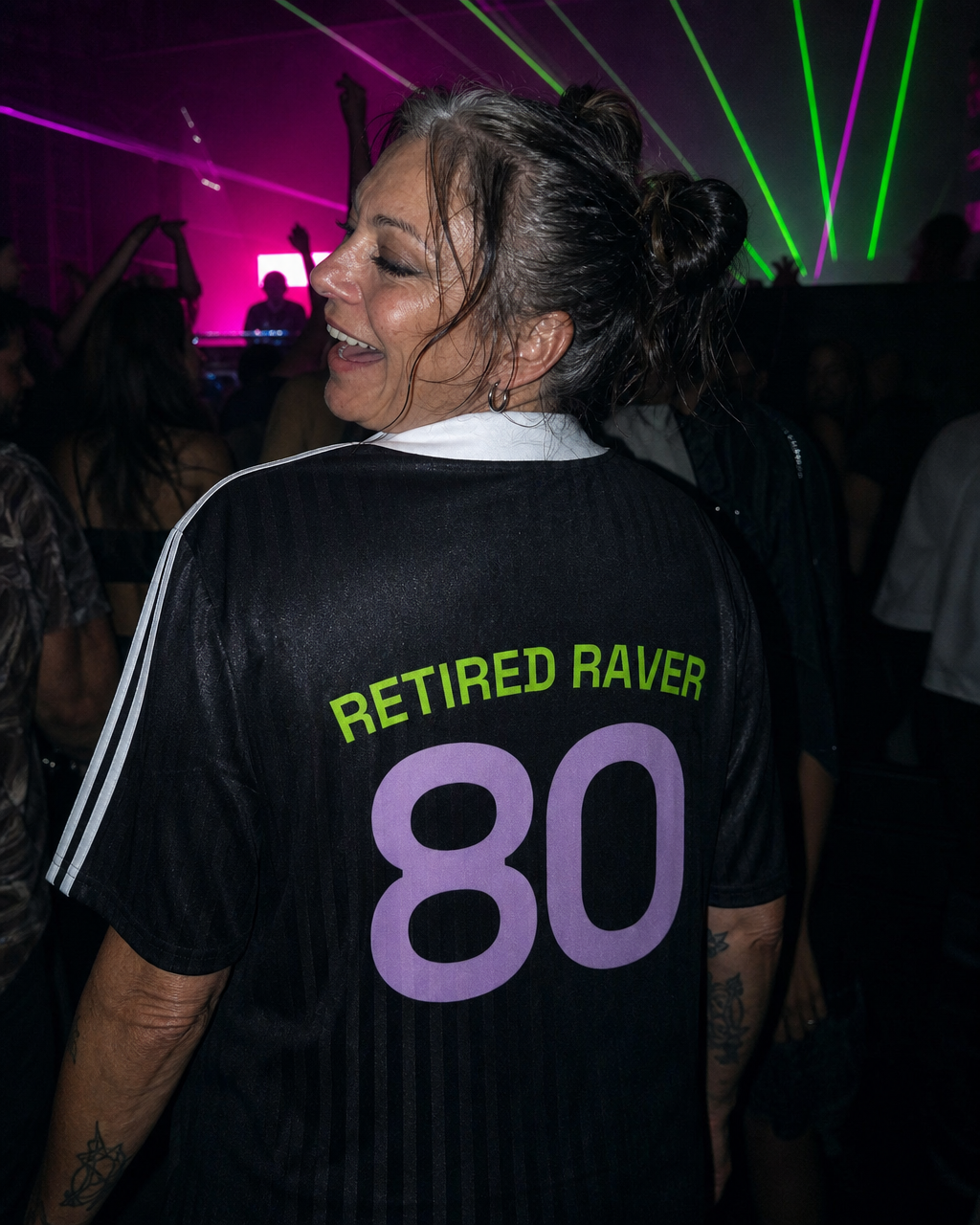
Bring water, earplugs, a charged phone and a realistic plan for getting home. That's it. That's the list.
The Honest Bit: Evidence, Limits and What Dancing Cannot Fix
Here's the part competitors skip. The evidence for dancing and mental health is still developing, and anyone claiming certainty is overselling it. The World Health Organisation's guidance on physical activity is clear that movement supports mental wellbeing, and Beyond Blue's resources on mental health are a good starting point if you want to understand what professional support looks like.
What dancing cannot fix: clinical depression, anxiety disorders, hormonal symptoms that need medical input, or a nervous system that's genuinely in trouble. Rave therapy is a complement to care, never a replacement. If symptoms are hitting you hard, it's always smart to speak to an expert via our friends at UnPause.com.au. Dead Tired Club does not provide medical advice.
If you want to keep moving without a gym membership, there are non-gym movement ideas for perimenopause that fit a wrecked schedule. And if you're not ready for a big night yet, you can start with a kitchen rave and see how your body responds.
Join the Club: Gear for Women Who Still Want to Go Out
Feeling confident is the whole point, and it starts before you leave the house. We make feel-good gear for women who still want to go out, including the Retired Raver Sporty Jersey and skincare like our copper peptide serum for the mornings after. Join Dead Tired Club and get gear that acknowledges the reality of exhaustion without asking you to be beige about it.
You've lived loud once. There's no rule saying that chapter closed at 35. Dead Tired Club exists for the women who are still going, just with better hydration and an earlier taxi. Get started with Dead Tired Club and find gear that fits the woman you still are.
Frequently Asked Questions
Why can dancing at a rave feel so uplifting?
Dancing combines rhythmic movement, loud music, sweat and company, and many people enjoy the buzz that comes with it. Moving to a beat can feel like a welcome outlet for the week, while the shared energy of a crowd adds a social lift you do not get from a solo workout. It is not a cure for anything, but as a way to shake off the week, a night on the dance floor can be a lot of fun.
Can dancing help improve your mood in midlife?
Some women enjoy dancing as a way to move, sweat and be around other people, and it can be a fun part of a balanced life. It also gives you something to look forward to, which matters when perimenopause has flattened your spark. If low mood is persistent or heavy, talk to a professional. Dancing is a brilliant addition to your life, not a replacement for proper care.
Is it too late to start going to raves in midlife?
Absolutely not. Rave culture has no age limit, and plenty of women in their forties, fifties and beyond are back on the dance floor. Start with smaller events, day festivals or live music gigs and see how your body and energy respond. Go with a friend, plan your exit and wear something you can move in. You might need more recovery time than you did at 22, but the joy is still there waiting for you.
How can I enjoy a rave if I feel tired or self-conscious?
Pick an event that suits your energy, such as an early set or a seated venue with a dance floor, and go with people who make you feel comfortable. Wear something soft and roomy, like a sporty jersey you can throw over anything, and remind yourself that nobody is judging you. If self-consciousness is loud in your head, start at the edge of the floor, dance like nobody is watching and let the rhythm do the rest.
